Saturday, 17 August 2013

IT'S MILLERS TIME


MOVIE
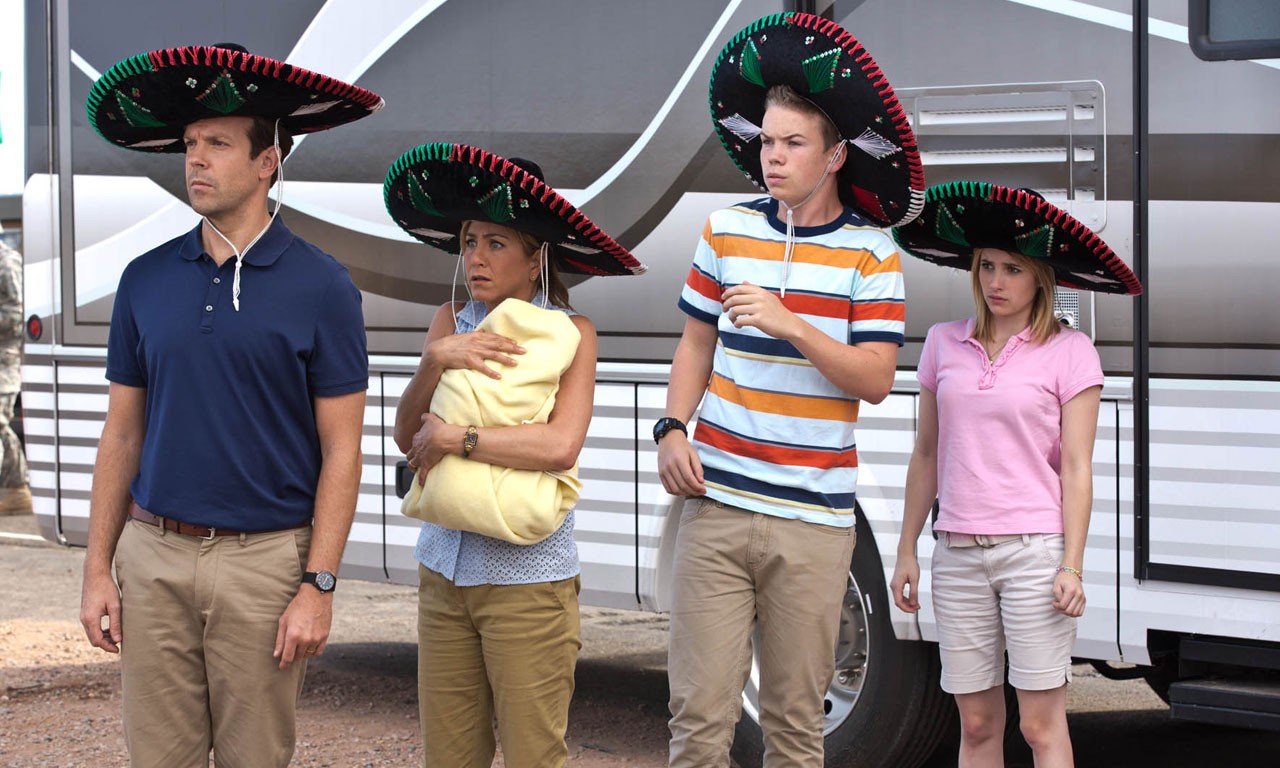
We're The Millers
Jason Sudeikis, Jennifer Aniston
Director Rawson Marshall Thurber
Review Ray Chan

This is the story of David Clark (Jason Sudeikis), a small-time pot dealer with a heart of gold.
    When his stash and cash are plundered, the pusher he works for, Brad Gurdlinger (Ed Helms), says all debts will be forgiven if he agrees to smuggle a shipment over the Mexican border.
    To enable him to get past the border patrol, David persuades his stripper neighbour Rose (Jennifer Aniston), homeless girl Casey (Emma Roberts), and the 18-year-old dork and fellow apartment dweller Kenny (Will Poulter) to pose as his all-American family, the Millers, planning to hide the weed in an RV and sail right across.
    Of course, things don’t go quite to the script, with the crew ending up being chased by a Mexican drug kingpin, having a series of bizarre encounters with another RV-driving couple (Kathryn Hahn and Nick Offerman), and struggling to keep their masquerade intact.
    The jokes themselves are often sexual or scatological, with gags about wife-swapping, sexual malfunctions, and tampons making prominent appearances, not to mention an unfortunate incident with a spider bite on a set of testicles.
    But while We're the Millers is very raunchy in its humour, at the very heart of it lies a sweet intent, being fundamentally a tale about a bunch of wacky misfits who secretly yearn for the kind of normality some people would take for granted.
    As their journey moves forward, the Millers find themselves assuming the characteristics of a real family. David and Rose develop a sense of parental protectiveness toward their “children”.
    While all of the cast play off each other well, Poulter is a standout and hilarious as the insecure Kenny, whether he's rapping to TLC's Waterfalls or awkwardly learning how to kiss from an inappropriate source.
    As the movie winds up, life lessons are learned by all. In some ways, this is the movie's best joke: that even complete screw-ups can find a sense of belonging when thrown together with other fellow oddballs.


#we'rethemillers


Thursday, 24 January 2013

TOP GUN


MOVIE
Django Unchained
Jamie Foxx, Christophe Waltz, Leonardo DiCaprio, Don Johnson 
Director Quentin Tarantino
Review Ray Chan

Tarantino may have his critics, but this movie probably typifies exactly how brilliant this filmmaker is.
   Bold, brave, blithe and bloody, Django Unchained is an incendiary masterpiece featuring a kick-ass tale of revenge with some awesome performances from its star-studded cast, smart chunks of dialogue punctuated by action, ensanguined altercations and stereotypical Western ballads, and for some unfathomable but highly entertaining reason, Tarantino himself with a ridiculous Australian accent.
    Jamie Foxx is Django (“the D is silent”), a slave being dragged by his masters in chains, when he runs into Dr King Schultz (Christoph Waltz, portraying a good guy for a change).
    Schultz needs Django to identify his former employers so that he can kill them and collect the bounty on their heads, and promises to set Django free once the mission is accomplished.
    They find the odious brothers on the sprawling cotton plantation of Big Daddy (hammed up impeccably by Don Johnson), and it doesn’t take long for Django to dish out some retribution for his past treatment at their hands. Schultz doesn’t care because he gets the reward anyway.
    Then the twists and turns keep coming. After Django relays the story of his missing wife, the wonderfully-named Broomhilda, to Schultz, the pair partner up to hunt bounties all winter with a plan to track her down in the spring and buy her back from her current owner—a vile, mustachioed gentlemen named Calvin Candie (Leonardo DiCaprio) who runs a plantation called Candieland.
    Suffice to say that efforts to rescue Broomhilda don’t go exactly to plan, with the plot meandering through a series of shocks, suspense and surprises, as Candie’s devoted slave Stephen (Samuel L. Jackson) figures out the real reason for Django’s visit.
    Indeed, Jackson’s performance is a highlight. Usually depicted as the rough, no-nonsense law enforcer or a vicious criminal, here he plays an exaggerated and extremely funny character calculated to make the audience laugh and then feel uneasy about how willingly they respond to his over-the-top delivery.
    Overall, the blend of classic film homages, violent spectacle and clever verbal exchanges ensures that Tarantino remains one of the most interesting and innovative movie maestros of his generation.
    On a more serious note, he makes a potent and powerful statement about racial stereotype and racist language, and even includes a post-credit gag to suggest the potential for such language to then be successfully appropriated.
    The end result is what I believe to be Tarantino’s best and most thoughtful film to date.


#djangounchained

Wednesday, 2 January 2013

GODLY SLICE OF PI


MOVIE
Life Of Pi
Suraj Sharmam, Irrfan Khan
Director Ang Lee
Review Ray Chan


It takes the pedigree of an Academy Award-winning director like Ang Lee to have the audacity to tackle what looked like a seemingly impossible literary adaption of Yann Martel's novel.
    Martel's story outlines the life-defining journey of a young man named Pi, whose zookeeping business family decide to travel to Canada from their Indian homeland — lock, stock and menagerie — to escape political problems there.
    
    On the way, their cargo ship gets battered by a fierce storm and capsizes.
    Pi manages to find a life boat, which bit by bit takes on various animals from the sinking vessel — a wounded zebra, a noble orangutan, a cackling, self-serving hyena, a regal Bengal tiger — who in the ensuing days turn on each other in the quest to survive.
    Eventually it’s just Pi and the tiger left stuck on the small vessel in the middle of the Pacific Ocean, a predicament that would test anyone’s sanity.
    To help him endure, Pi digs deep into the recesses of his eclectic convictions that a god exists to keep him alive, and this journey is rendered impeccably by Lee's vision. The colour is electric, with iconic and stunningly sublime shots littered throughout.
    Whether it's magnificent underwater shots of the ship plunging to the watery depths, a grand whale breaching to the skies, or the infinite glacial look of an ocean, Lee's stunning composition is omnipresent, as is the technical wizardry used for the animal stars of the film, which make them wonderfully realistic.
    Veteran Irrfan Khan plays the older Pi, who narrates the tale, while the younger version is represented by Suraj Sharma, who does an impressive job of absorbing the harrowing physical torture without extinguishing his optimism, belief and hope, successfully emoting without any real creatures to play off of.
    If you haven’t read the book, you are in for a treat as you gradually realise the movie is all about symbolism and metaphors.
    As the film nears its end, a rescued Pi tells two versions of his adventures: the animal story and a human interpretation. It’s then that the realisation dawns, if it hasn’t already, that the ragtag group of animals were likely anecdotal manifestations of crew members who clambered on board with Pi.
    After recounting his experiences, Pi asks his rescuers, and indirectly the viewers, which rendition they prefer.
    Pi maintains it was his faith that got him through, and here he provokes a person to believe in the presence of a higher being.
    He is challenging the viewer to consider which version of the world they prefer 
— the one where we make our own way and suffer through the darkness via self-determination, or the one where we are aided by something greater than ourselves (regardless of which diety we may follow).
    Is the tiger in fact how Pi sees God, who helped him get through adversity when all seemed lost? Is the tiger Pi himself?
    Ultimately, Life of Pi is a beautiful allegory about living with acceptance in the face of the most formidable of adversities.
    The consensus from the hardened investigators interrogating Pi as he recovers is that the animal version is too fanciful to believe, but a much happier one to accept.
    “And so it goes with God,” Pi says as the movie ends.

#lifeofpi


Monday, 24 December 2012

I SCREAMED A SCREAM


MOVIE
Les Miserables
Hugh Jackman, Russell Crowe, Ann Hathaway
Director Tom Hooper
Review Ray Chan

IF you like your musicals big, bombastic and blasting on all cylinders, then this is the movie for you.
    The cinematic sweep works pretty well at times, right from the opening scene, in fact: a chain gang of prisoners labouring to pull an enormous ship into dry dock looks like authentic toil, and has a decent shock moment when the camera searches the faces and finds the emaciated Prisoner 24601, Jean Valjean (Hugh Jackman), imprisoned for 19 years for stealing a loaf of bread.
    The protagonist of Victor Hugo’s novel, Valjean is put on the path to goodness by a generous gift, but pursued relentlessly by Inspector Javert (Russell Crowe), who doesn’t believe in redemption.
    Then after 90 minutes, the stage becomes vastly more crowded as other characters from the narrative are introduced.
    Valjean rescues Cosette (Amanda Seyfried) from a couple of unscrupulous innkeepers (Sacha Baron Cohen and Helena Bonham Carter), who then travels to Paris and falls in love with idealistic French student Marius (Eddie Redmayne), who has joined a band of brothers fighting in the revolution.
    Indeed, with the entire saga set in France, it’s interesting to note the cosmopolitan make-up of the cast, which includes Britons, Frenchmen, Americans and Antipodeans, all of whom make no attempt to hide their native accents.
    The exception is Cohen, who for whatever reason adopts a random Inspector Clouseau inflection, which contrasts wildly with the perplexing Jack Wild-esque Cockney-speak of Daniel Huttlestone as the French urchin Gavroche.
    With so many different characters, there are bound to be moments when viewers feel scenes are rushed, or lacking deeper exposition, but any flaws in the adaptation are more than made up for by Jackman’s performance.
    Apart from a solid showing as the anguished lead, Jackman surprises with his tenor vibrato, standing up against the best of the actors who have played Valjean, particularly in What Have I Done, dragging you into the film so completely you can almost feel his spit on you, and on the difficult Bring Him Home, where the verses hit notes that only dogs can hear.
    More surprising and impressive is the portrayal of Fantine by Anne Hathaway.
    Her solo I Dreamed a Dream is the first significant test for director Tom Hooper’s gamble of recording his actors performing live in one take, with flat notes and rough edges preserved and not re-done in the safe haven of a studio.
    The two shining stars really brighten up what we need to remember is foremostly a musical, but unfortunately, not all their peers are as vocally blessed, with the biggest culprit being Crowe.
    It’s not unfair to say that when Les Mis is good, it’s very, very good; but when it is bad, it’s usually because the Gladiator star has tried to sing.
    Crowe, whose professional crooning career peaked with pub band 30 Odd Foot of Grunts, is a sorry simulacrum for the angry Javert, cooing dramatic songs as if they were lullabies.
    Ultimately, adapting beloved oeuvres into a new medium is always a tricky prospect. Whether it's a comic book, a stage play, or in this case, a great work of literature, if makes it to the silver screen, chances are that there is a fairly devoted fan base who will let you know in no uncertain terms if you screw up their baby.
    In Les Mis, if they can overlook the unevenness of some of the musical numbers, they will probably raise their thumbs.
    While there's a slight disconnect from the source material, there's also an undeniable passion and respect for the magnum opus, which runs for more than two-and-a-half hours.
    It may be overlong and even test one’s patience, especially those who are not into Broadway shows or singing and dancing theatre pieces, but as cinematic musicals go, it’s generally one of the more sumptuously-crafted productions in recent years.


#lesmiserables


Saturday, 27 October 2012

MEGA IMPRESSIVE


MOVIE
Dredd
Karl Urban, Olivia Thirlby
Director Peter Travis
Review Ray Chan

Wow, wow, wow. In a year that’s dished up some hardcore super-hero fare in the form of The Avengers, The Amazing Spider-Man and Batman: Dark Knight Rises, it’s pleasantly surprising to discover that the best in this genre so far is this adaptation of the classic British character.
    Dredd is a fantastic film: sharply focused, true to the spirit of the comic book character, and filled with ratcheting tension and killer action set pieces.
    Shot and designed for a 3D experience, the film’s policeman protagonist is played superbly by Karl Urban wearing his best grimace and scowl.
    A new drug called Slo-Mo is circulating through Dredd’s grim future metropolis Mega-City One, with its users experiencing reality in a slowed-down state that is visualised in 3-D with stunning clarity and colour.
    What could have been a gimmick becomes a central plot device and a trademark visual of the movie. The experience of falling off of a skyscraper on Slo-Mo, for instance, feels like eternity for the poor falling victim.
    It’s a fine testament to the skills of director Pete Travis and cinematographer Anthony Dod Mantle, who pull out all the stops in making the sequences pop, ripple, and explode.
    Part of the appeal of the movie is the linear fashion of the storyline, which goes from start to finish without meandering on confusing diversions.
    Dredd and his new trainee, psychic recruit Anderson (Olivia Thirlby), answer a call to the nearest triple homicide, and soon find themselves trapped in the slum tower of the dreaded gangster Ma-Ma, with no way to escape except to kill ’em all.
    In this apocalyptic future, Dredd has the power of judge, jury and executioner, while at the same time being the uncontested hero of the story. There’s a wonderful balance struck between thrilling entertainment and the square-jawed triumph of The Man.
    It’s a straightforward good guy versus bad guy showdown and one almost feels that Dredd’s singular and unwavering devotion to the law is the key to holding this tenuous society from teetering right off the brink.
    Famously never depicted without wearing his signature helmet, Dredd is always The Law, a trope abandoned in Sylvester Stallone’s disappointing version of the same character several years ago.
    Succeeding as an action movie, a comic book adaptation, a tonally tricky science fiction narrative, and a visually compelling live action adaptation, Dredd is one of this year’s most memorable cinematic offerings.


#dredd


Friday, 5 August 2011

HAIL CAESAR


MOVIE
Rise of the Planet of the Apes
James Franco, Andy Serkis
Director Rupert Wyatt
Review Ray Chan

I’M old enough to remember watching the original Planet of the Apes series as a kid in the 60s and not being impressed by Charlton Heston, Roddy McDowall and co, who appeared even to my young eyes to be just humans wearing masks with mouths that did not close shut when talking, even if the prosthetics were ground-breaking at the time.
    And unbelievably, the make-up was considered even worse for Tim Burton’s lightweight 2001 remake, which was critically panned.
    So the trepidation was high as the lights fell on the first instalment of the newly energised franchise, rebooted for the times. But it was needless, as today’s technology reveals that you too can believe that a monkey can talk.
    In San Francisco, Dr Will Rodman (Franco), a brilliant genetic engineer working for a typical money-hungry conglomerate, wants to cure Alzheimer’s to save his fading father (John Lithgow).
    He designs a serum aimed at repairing the brain, but it does something even better in one of the chimps on which it has been tested, boosting her intelligence without any noticeable side-effects.
    As time passes, the subject duly gives birth to a chimp which had the magic potion delivered to him in utero.
    When she breaks free from her shackles at being separated from her child, she is killed by panicked security guards, which encourages Will to take the orphan chimp home as his own, naming him Caesar.
    As he grows, he proves to be not just smarter than other apes of his species, but smarter than humans of similar age as well.
    He also picks up language better than a human kid, and as he develops from baby to moody adolescent, his vocabulary and curiosity expands even faster, as do his expectations of what he wants from the world from which he is isolated, but which he watches in fascination from his attic window.
    Over-riding the weird science factor – in which viewers may question whether such fanciful notions are possible – is the emotional tug in the storyline which focuses on father-and-son relationships, as Will does everything he can to find the cure for his dad’s disease, yet thinks with his heart when it comes to taking care of his surrogate son.
    No moment is more poignant than the one when Caesar asks whether or not he is regarded as a pet. It’s a theme that lurks throughout the film, as animals who haven’t had Caesar’s advantages are treated without regard to their status as entities with feelings.
    The primate prodigy's world changes when he protects Will's dad from an aggressive neighbour, causing injury in the process. He is sent to a simian shelter where he assumes the alpha role among the caged menagerie of chimps, baboons, gorillas and orangutans.

    Caesar eventually breaks free from the facility and uses canisters of Will's drug to enhance the abilities of his new-found tribe, which he also liberates into the city, including some apes from the zoo for good measure.
    The camerawork is brilliant as the lens zooms in on the apes, swooping madly while negotiating the world on their terms, whether it’s crashing from room to room in the Rodman household, through the wilds of the surrounding woods, or swarming the Golden Gate Bridge in a devastatingly effective action sequence that plays to emotion and adrenaline.
    The star of the movie is undoubtedly Caesar, and that means actor Andy Serkis (seemingly making a habit of playing fantastic beasts), who puts in an absolutely triumphant performance.
    While the use of CGI has transmuted his appearance into that of a chimp, the actor creates a character of vivid complexity, the anthropoid face and form as full of empathy as that of a human.
    The childlike joy, the troubled confusion, and finally a stare of cool, focused malevolence as Caesar stands up to a tormentor, physically and intellectually, is gripping for its intelligence and for its inexorable desire for retribution.
    Rise Of The Planet Of The Apes is a splendidly wrought cautionary tale about good intentions going astray, but one executed without sounding too preachy.
    It combines smart storytelling with groundbreaking effects to create an experience that is gripping from start to finish, standing as proof that the best movies entice us not just because of the mayhem, but from the ability to make us care why it's happening.
    The deliberate open ending of the movie sets up the promise of a sequel (or two), and if the same standard of emotion and adventure can be maintained, then it is something to look forward to indeed.


#riseoftheplanetoftheapes


Friday, 10 June 2011

LIGHTS, ACTION ... CAMERA


MOVIE
Super 8
Kyle Chandler, Joel Courtney, Elle Fanning
Director JJ Abrams
Review Ray Chan


Joel Courtney leads a cast of talented kid actors as Joe Lamb, the middle-school-aged son of Jack (Kyle Chandler), a sheriff’s deputy who struggles with the demands of single parenthood after his wife dies in a steel mill accident.
    Joe copes by escaping into a world of models and monster magazines, and fills his free hours making a zombie film with his movie-mad pal Charles (Riley Griffiths).
    Filming surreptitiously at an abandoned train station one night, they witness a train derailment that ushers in a series of mysterious happenings that might be explained by events they unwittingly captured on the Super 8 camera.
    The scene is presented brilliantly as the sound of screeching metal fills the air while cars tumble aimlessly across the tracks.
    It’s the first of many sequences which show the influence of the movie's producer Steven Spielberg on J.J. Abrams, who readily admits that this new offering is a homage to the man who has become the most successful director in Hollywood history.
    Abrams shows he has been a keen student of Spielberg’s techniques, adopting style and substance from Jaws to E.T. to Close Encounters, with parts of The Goonies thrown in for good measure.
    Saying more about what happens after the train incident would spoil Super 8’s carefully cultivated aura of mystery, but suffice it to say that what follows won’t be too surprising to those who have seen the aforementioned films that lend this their DNA.
    That makes the picture both welcomingly and frustratingly familiar, and more the latter as it goes along.
   But A for effort. Super 8 constructs a believably complicated small-town world, fills it with the right period details and shoots it beautifully, testing the residents’ sense of order and willingness to stand up to authority to cope with a chaotic element that could destroy them.
    Borrowed the pleasures may be, but who better to imitate if the object is to flatter?


Thursday, 11 November 2010

THE MAIM MAN


MOVIE
Machete
Danny Trejo, Robert De Niro
Director Robert Rodriguez
Review Ray Chan

IN his collaboration with Quentin Tarantino on the two-in-one thriller Grindhouse, Robert Rodriguez introduced a mock trailer for a fake movie called Machete, starring craggy-faced, veteran character actor Danny Trejo as an intimidating Mexican day labourer.
    Now, in tribute to violent, low-budget 70s exploitation pictures, that ‘coming attraction’ has become a testosterone-fuelled reality.
    The minimalist plot behind this action film – with so many over-the-top sequences that it could really be labelled a comedy – revolves around main (and maim) man Machete (Trejo), a badass ex-Mexican Federale who is seeking revenge against the vicious drug lord who killed his wife and daughter.
    Within the opening minutes, he’s chopped the heads and arms off a dozen gangsters guarding the kingpin Torrez (Steven Seagal), but comes off worse for wear.
    Left for dead, Machete recuperates and flees over-the-border to Texas, where he’s coerced under threat of deportation to accept a job to kill conservative, intolerant Texas Senator McLaughlin (Robert De Niro), who denounces illegal immigrants as parasites, and enjoys driving with sadistic, rifle-wielding Von (Don Johnson), shooting unarmed Mexicans they find sneaking into the country.
    But it’s a set-up and when he’s identified as the would-be perpetrator of the failed assassination, Machete’s only allies are his brother and less-than-pious priest Padre Benito (Cheech Marin), and Luz (Michelle Rodriguez), the proprietor of a taco truck and leader of the underground resistance called ‘the Network’.
    Then there’s scantily clad Sartana (Jessica Alba), a luscious Immigration and Customs Enforcement agent, and slutty April (Lindsay Lohan), the entitled, drugged-up daughter of McLaughlin’s associate Booth. Mix them all together and you get a cocktail of murder and mayhem.
    Rodriguez and his co-director Ethan Maniquis may be only junior-grade Tarantinos, but they assemble enough ludicrous, offensive, politically incorrect genre conventions – like bigoted hombres, naughty nurses, double-entendred dialogue and slightly-clad bodacious babes – to score the film as one of this year’s most surprising must-sees.
    And they’re already planning two sequels – this time, the trailers are real. SĂ­, por favour.


Saturday, 14 August 2010

MEATHEAD MASTERPIECE


MOVIE
The Expendables
Sylvester Stallone and his mighty men
Director Sylvester Stallone
Review Ray Chan

CLEARLY, Sly knows his audience and what they have come to expect of him.
    Never mind his odd dalliances here and there into other roles, he knows he is most clearly identified with the tough guy personas he portrayed in the likes of Rambo, Rocky, Cobra and Demolition Man.
    So with The Expendables, Stallone is back doing what he does best – kicking ass and keeping us entertained.
    You could imagine what went through his mind when he conceived the idea – grab every action man in Hollywood and put them together in one mega-adventure.
    By and large, he succeeded, with the exception of a couple of big name stars who wanted more money.
    Stallone would probably be the first to admit The Expendables is not a great film, nor even a great action movie, at least not by today's big-budget slam-bang standards.
    But it’s a damn lot of fun: a great slice of classic meat-and-potatoes musclebound '80s action which proves that, on a modest budget, gripping set pieces and sharp action spectacles can be created without lashings of CGI and flashy editing.

    With a cast featuring the likes of Jason Statham, Jet Li, Dolph Lundgren, Bruce Willis, Arnold Schwarzenegger, Steve Austin, Terry Crews, Mickey Rourke and of course Sly himself, this is undoubtedly the guiltiest of guilty pleasures, as we follow a group of elite mercenaries deployed to the Gulf of Aden to save hostages on a vessel from Somali pirates.
    There’s hardly any storyline, but The Expendables should more than please any hardcore action nut looking for a good old-fashioned, star-studded brawl.


Friday, 9 April 2010

KICKING UP A STORM


MOVIE
Kick-Ass
Aaron Johnson, Chloe Grace Moretz, Nicholas Cage

Director Matthew Vaughn, Jeff Vadlow
Review Ray Chan


Average American teenager Dave Lizewski (Aaron Johnson) and his friends, Marty (Clark Duke) and Todd (Evan Peters), read comic books and talk about girls.
    Then the lightbulb comes on in his mind: why have people never tried to re-create themselves as super-heroes?
    The movie is an account of Dave’s efforts at becoming a costumed crimefighter, and it’s a bawdy, hilarious action comedy brimming with outrageously vulgar jokes.
    Lacking funds and most of the skills, Dave settles for a home-made outfit and a name apparently devised to create fear in the minds of evildoers: Kick-Ass.
    At first vigilantism proves harder than Dave expected, but eventually the ‘hero’ becomes a sensation, with video of his mildly impressive exploits burning up YouTube.
    The girl he’s in love with, Katie (Lyndsy Fonseca), is among those smitten with the masked avenger, but of course – ala Lois Lane – she doesn’t know it’s him. She’s only interested in Dave as a friend, and only because she thinks he’s gay.
    As Kick-Ass goes about helping people who have brought their plights to his attention through his MySpace page, he encounters a couple of amateur heroes who are taking the business a lot more seriously than he is: a 12-year-old assassin called Hit-Girl (Chloe Grace Moretz) and her father, Big Daddy (Nicolas Cage).
    Like the Batman, they have vast financial resources and a personal vendetta fuelling their missions; but unlike the caped crusader, they have no compunction about killing people if necessary.
    Through them, Kick-Ass gets involved in a caper surrounding millionaire crime boss Frank D’Amico (Mark Strong) and his son, Chris, who as it turns out is also a schoolmate of Dave’s.
    The movie is based on a concept created by comic book writer Mark Millar, who has an astonishing number of other titles being considered for theatrical adaptation.
    To his credit, director Matthew Vaughn makes no attempt to soften the violent, rowdy humour of the funny book for the big screen, nor to sidestep the fact that one of the most lethal and foul-mouthed characters is a pre-teen girl.
    He invites Johnson, Moretz, and Cage to let loose and enjoy themselves in their roles, and this they do, especially Cage, who in real life is himself an avid comic book collector.
    The result is a film that does not lack for big laughs and ends up as a raucous crowd-pleaser, one that indeed kicks sufficient ass.


Saturday, 12 December 2009

ABORIGINAL AND ORIGINAL


MOVIE
Bran Nue Dae
Rocky McKenzie, Geoffrey Rush
Director Rachel Perkins
Review Ray Chan


When it comes to Australian musicals – and that means those actually set in the country, and not the several international movies directed by Aussies – you can probably count the memorable ones on one hand. Priscilla, Shane Warne, The Boy From Oz …. and now I’m glad to say you can safely add Bran Nue Day to the list.
   This lovable, exuberant film does not pretend to be anything but a celebration of indigenous life, as typified in the lyrics of its standout musical number, when the characters sing "there's nothing I would rather be, than to be an Aborigine" … although there is a slight nod at social commentary with the caveat "and watch you take my precious land away".
    It’s a far cry from many movies with Aboriginal themes, such as Rabbit-Proof Fence or The Chant of Jimmie Blacksmith, which tended to be more serious and depressing in their portrayal of racial mistreatment and exploitation.
    But thanks to the energy of the music and dance sequences, the vibrance and verve of the cinematography, and the ebullience of the multi-racial cast, the audience takes away a sense of conviviality more than any sort of bleak history lesson.
    Bran Nue Dae is set in 1969 in the mixed-culture pearling town of Broome in Western Australia.
    The handsome but hesitant Willie (played by Broome-born actor Rocky McKenzie) is besotted by aspiring singer Rosie (Australian Idol star Jessica Mauboy), but finds his efforts thwarted by the more outgoing Lester (Dan Sultan), who fronts the local band.
    Meanwhile, Willie's mother, determined to see her son become a Catholic priest, dispatches him to a seminary school in Perth run by a stern German, Father Benedictus (hammed up hilariously by Geoffrey Rush), but a homesick Willie duly absconds and hits the trail back to Broome, catching a ride in the Kombi van of two young hippie tourists.
    Along the way, they meet a homeless Aborigine under a bridge (Ernie Dingo), who claims to be the boy's uncle and comes along for the ride.
    Various adventures ensue, some of them involving a sexually frustrated roadhouse owner (Magda Szubanski in a nice cameo) and members of the Chooky Dancers, punctuated by invariably lively song-and-dance numbers.
    There’s a high-energy spontaneity and goofiness here that blends with honest emotions and sound comedic moments.
    You never know when a song is going to break loose, and that’s part of the charm of this film, which boasts an eclectic soundtrack of country-rock, bluesy jazz, and some touching and traditional ballads, exemplifying the randomness and casualness of the script.
    The musical on which the movie is based was written by another of Broome’s heroes, Jimmy Chi – a playwright of Asian/Aboriginal descent – and was originally scripted as a stage play, filled with frolic and farce.
    Director Rachel Perkins has successfully transferred this spirit to the screen, with the movie culminating in an unexpected twist and musical reprise that cannot help but send the viewer away feeling good and floating on air.


ATTITUDE WITHOUT ALTITUDE

  MOVIE Supergirl Director Craig Gillespie Review Ray Chan The film begins with a super-powered dog relieving itself in spectacular fashio...