Thursday, 18 June 2015

AUSSIE EDGE TO FEEL-GOOD FARCE


This review was published in The West Australian dated June 18, 2015.


MOVIE
Alexander's Terrible, Horrible, No Good, Very Bad Day
Steve Carell, Jennifer Garner, Ed Oxenbould
Director Miguel Arteta
Review Ray Chan

The live action adaptation of Judith Viorst's highly amusing children's book has finally made it to the screen, after a checkered start which involved a change of film studios and director.
    But while the Walt Disney Studio's picking up of the movie from 20th Century Fox because of budgetary reasons is nothing more than an occupational hazard in the business world, what's surprising is acclaimed independent creator Miguel Arteta's decision to fill the chair left vacant by Lisa Cholodenko, who also happened to write a first draft of the screenplay (eventually completed by Rob Lieber).
    Renowned for his innovative television and movie filmmaking, Arteta shows little of this edginess as he plays it safe with this feel-good comedy that delivers more than this reviewer, at least, expected as he walked warily through the cinema doors.
    The premise of the story centres on young 11-year-old Alexander, who feels as if every single one of his days is terrible, horrible and no good, particularly when compared to the almost-perfect lifestyles of his parents and siblings.
    But when Alexander tells his upbeat family about his misadventures, he finds little sympathy and begins to wonder if bad things only happen to him.
    Finally, Alexander can take it no more. On a day when he wakes up to gum in his hair, accidentally mangles his baby brother's favourite bumblebee pacifier in the sink disposal unit, misses out on a window seat in the car pool (yet again), gets unflattering Photoshopped images of him distributed to his friends, sees his birthday plans usurped by a student who promises a more extravagant celebration, and almost destroys the school lab in an effort to impress his crush, Alexander wishes that everybody else could experience his misfortunes.
    Aussie Ed Oxenbould makes a fine movie debut as Alexander, who from that wish on sees his family encounter mishap after mishap, enough to convince him that it was his selfish whims which somehow cast a spell of disaster on everyone's day.
    If the surname sounds familiar, it should; Ed is the nephew of Australian actor Jason Oxenbould, who played the teenaged Ben in the TV sitcom Hey Dad!
    Indeed, there is a distinctive Australian flavour to the film. A running gag throughout the book involves an exasperated Alexander repeating several times that he wants to move to Australia (presumably because he thinks it's better here).
    In the movie, Alexander's preoccupation with Australia is extended to an obsession, with his bedroom surrounded by all manner of Australian paraphernalia, while a dalliance with Vegemite on toast causes his sister to coil in disgust.
    As Alexander's father, the accomplished Steve Carell waltzes through the role in his inoffensive, charismatic, slapdash fashion, while the performances of the rest of the cast are solid, although one might not expect any less given the less-than-challenging material.
    Arteta ensures the overtures of familial affirmation are not conveyed with too much saccharine, while the many comedic interludes carry through successfully without slipping into slapstick.
    The movie runs a little less than 85 minutes, not too long to have the younger audience fidgeting, but is also filled with enough fast-paced fun and frivolity to sustain the attention of the older moviegoers.
    There's enough use of tweets, mobile phones and Gen Z whiz kids to give this interpretation of Alexander's THNGVBB a modern-day twist, but the message remains ostensibly the same; that, in Alexander's words, "you have to have the bad days so you can love the good ones", helped by "steering the ship with positivity".
    Hardly terrible, horrible or no good, the film is enjoyable family fare, right from Alexander's first disaster to the grand Aussie-themed finale, which could arguably do more for this country's tourism prospects than any of its recent high profile advertisements.


Thursday, 14 May 2015

HIT THE ROAD, MAX


MOVIE
Mad Max: Fury Road
Tom Hardy, Charlize Theron
Director George Miller
Review Ray Chan

HOLY COW. This movie, surely one of the best action films of all time, must put Aussie director George Miller on the pedestal with the greats.
    Mad Max: Fury Road is a relentless, nonstop and breathless post-apocalyptic thriller, starring Tom Hardy as Max, who wanders the desolate wasteland of his shattered world simply trying to survive.
    It makes up for what it lacks in storyline and character development with a groundbreaking blend of battle flick tropes and death-defying stunts atop a constantly moving canvas of motor-driven insanity.
    Even the set design astounds, with imaginatively redesigned vehicles such as tanks with caterpillar tracks for wheels and long-spiked dune buggies, ridden astride by drivers on collapsible stilts and catapults, and led by manic punk rockers blazing out heavy metal riffs on killer guitars.
    Indeed, the cars themselves are fully developed characters, exemplified by the Gigahorse, a six-wheeled behemoth made up of two fin-tailed Cadillacs stuck together with mounted rifle stands attached on its back.
    Miller, the creator and director of all of the Mad Max films, delivers a shamelessly badass rock ‘n’ roll dystopian chase movie, and the viewers are taken on the ride right from the start.
    Fury Road moves at breakneck speed from beginning to end, offering only the merest of brief respites when the viewers can catch their breath to prepare for the next jaw-dropping sequence.
    The picture’s depth lies in its blistering backbeat of fast-paced action fulfilled by a cast of gnarly Wild West-inspired characters “living to die and dying to live”, in a setting where a lack of water and oil has turned humanity into hordes of people living by their primal instincts.
    And then there’s the focus on feminism, with Charlize Theron’s uncompromising bionic-armed heroine, Imperator Furiosa, leading the lion’s share of the action.
    Oil truck driver Furiosa turns a fuel delivery into a rescue mission to transport five mistresses away from Immortan Joe (played by Hugh Keays-Byrne in a franchise return), the demonic despot who controls the flow of water to the starving masses.
    Furiosa and her femmes are no slouches at holding their own, and often Max is simply along to serve as facilitator with his muscle and proficiency with weapons.
    This is truly a movie in which action speaks louder than words. Miller and his production team fill the screen with a wide variety of amazing and impressive stunts, which will have you gaping in disbelief, while holding the dialogue to a minimum.
    Fury Road is a thoroughfare lined with road rage and mayhem, wit and touches of grace and humanity that will make you want to go on a return trip.


#madmaxfuryroad


Wednesday, 4 February 2015

SPY-JINKS


MOVIE
Kingsman: The Secret Service
Taron Egerton, Colin Firth 
Director Matthew Vaughn
Review Ray Chan


The best parodies are the ones done with the right amount of homage and humour, and you’ll find no better example than Kingsman: The Secret Service.
   Based on The Secret Service comic book created by Dave Gibbons and Mark Millar, and directed by Matthew Vaughn (Kick-Ass, X-Men First Class), the movie is a pastiche of the secret agent franchise done with deliberate comedy, élan and obvious affection.
    It centres on a British spy organisation staffed by Savile Row-suited toffs, including the impeccably mannered Harry Hart (Colin Firth), who recruits the young son of an ex-colleague for whose death in a Middle East conflict he feels responsible.
    The curiously-named Eggsy (Taron Egerton) is initially rough at the edges and on the cusp of criminality in his London council estate, where he lives with his mum and her violent boyfriend.
    The first part of the movie deals with Eggsy's induction and training, where he's constantly pranked by the typical ineffectual bravado-filled Kingsmen recruits; of course they turn out to be more faint of heart than hardened when the chips are down, while Eggsy shows he has the right stuff.

    Once his mettle is proven and he is signed on, the clichés abound as Eggsy enters an ultra-secret underground world through a false door in a tailor's shop, filled with gizmos and weaponry that any self-respecting espionage emissary  would be proud to own – a deathly signet ring, shoes with a killer blade, a bulletproof umbrella – overseen by Mark Strong as the techie overlord Merlin, the equivalent of James Bond’s Q.
    The villain of the piece is madman billionaire businessman Richmond Valentine (Samuel L Jackson with a comical lisp), whose megalomaniacal vision is to control the world's population through mobile phones, abetted by his martial arts mistress Gazelle (Sofia Boutella), who bears  Oscar Pistorius-style lower limbs with ultra-sharp blades that she uses to great effect in several bloody action sequences.
    There are some great cameos as well. Mark Hamill (yes, him) shows up as a genius scientist, while Michael Caine plays the spy agency’s chief, as opposed to a spy itself, a role he has portrayed many times.
    Harr
y and Eggsy have to stop Valentine's dastardly plan, involving a blitz of explosions, shoot-outs, thrilling stunts and the rescue of a Scandinavian princess who, by intent or otherwise, resembles a certain Danish queen of Australian descent.
    All in all, Kingsman is dashing fun, what-ho. Every character, every frame, and nearly every line of dialogue is delivered with glee, turning every spy thriller cliche on its head, milking them for maximum amusement.
    Silly and cartoonish, the movie has its tongue firmly and delightfully in its cheek, and will delight as a well-executed mash-up of espionage and true cinematic excitement.


#kingsman

Monday, 2 February 2015

DOCTOR IN THE HOUSE


This review appeared in The West Australian dated February 2, 2015.

CONCERT
Doctor Who Symphonic Spectacular
West Australian Symphony Orchestra
REVIEW RAY CHAN

Suitably for a Doctor Who tribute, the majestic blue-hued Perth Arena gives the impression of being smaller than it looks from the outside.
    Fans who flocked into the tesseract-like structure on Saturday evening could be forgiven for thinking they'd wandered into their own personal Tardis, to be swept into a musical wonderland inhabited by the greatest hits from the good Doctor's TV shows.
    Perth was the second stop of the current Dr Who spectaculars, the shows featuring the music of composer Murray Gold and conducted by Ben Foster, and soprano Antoinette Halloran adding her voice on a few of the pieces.
    Each state supplies its own orchestra and WA is certainly fortunate to be served by the WASO ensemble, one of our busiest performing arts organisations, with a well-justified reputation for excellence, engagement and innovation, and who played throughout without missing a beat.
    In a sign of the playfulness to come, the performance began with a warning from the feared Cybermen for viewers to stay in their seats and to turn off mobile phones.
    Augmented by videos on the massive screens, the dramatic opening score of A Good Man introduced Halloran to the audience, as well as Peter Capaldi, the latest regeneration of The Doctor.
    Appearing through the ensuing mist, the affable Peter Davison, who played the fifth Doctor, narrated with moxie and mirth as he provided information about each piece, while injecting some humour into the proceedings, often at the expense of the sixth Doctor, Colin Baker, who has gained a bit of weight since his appearances in the role.
    The seating arrangement on the floor did seem unusual, with chairs ordered in blocks with generous gaps in between. But it was soon revealed why.
    A multitude of monsters and aliens appeared at various stages throughout the show, meandering between seats and mingling with the guests: my Whovian companion pointed out a Silurian, The Foretold, The Teller, a couple of Ood, Whisper Men, an Ice Warrior and, of course, the Daleks.
    Most of the works represented the grandiose nature of the modern series, enhanced by smartly choreographed lighting routines.
    The Doctor’s Theme spotlighted the first glimpses of the new breed, Christopher Eccleston and David Tennant, only adding to the fans’ elation, while Song Of Freedom allowed the beautiful voices of the WASO choir to shine.
    A tribute suite to those who travelled with the Doctor, The Companions, again featuring Halloran, was well-received, particularly as the screens gave air time to many old friends from throughout the decades.
    Foster, now clad in Davison's Dr Who coat, led a rousing interpretation of The Pandorica Suite, while Fifty-This Is Gallifrey and the Death In Heaven Suite provided an anthemic end to the proceedings.
    Of course, the show wouldn’t be complete without a rendition of, as Davison rightly claimed, the best science-fiction theme of all time.
    Theremins are rarely used instruments but surely their presence has never been more strongly felt than in the introduction of this classic piece, which in fact was written by an Australian composer, Ron Grainger.
    Whoever was picked from WASO to play the sound generator did it well, culminating in a roaring version of the refrain by the whole orchestra and sending fans and followers into raptures, no doubt wishing the Arena was indeed a time box that could whizz them to the future when the next spectacular comes round again.

Friday, 26 December 2014

HERO, HEART AND HUMOUR


MOVIE
Big Hero 6
Scott Adsit, Ryan Potter
Director Don Hall, Chris Williams
Review Ray Chan

DISNEY’S Big Hero 6 is set in a pan-Pacific technopolis called San Fransokyo, setting the scene for a mix of American and Japanese influences throughout the movie.
    And just like that curious mix of cultures, the studio seems to have surgically implanted the plush heart of a Pixar movie into the lumbering mechanical body of a Marvel property.
    Hiro Hamada (Ryan Potter) is a wayward boy genius whose equally gifted brother is killed in a freak explosion, leaving Hiro with a well of grief and his sibling’s masterwork invention, a robotic “health care companion” named Baymax, who’s amorphous, affable and emphatic.
    The initial scenes between Hiro and his new-found wide-eyed (in more ways than one) associate are among Hero‘s best, but the film shines with its climax, a smash-and-fly action fest involving Hiro, Baymax, and four research buddies who equip themselves as tech-assisted warriors to take on a masked supervillain controlling millions of tiny swarming micro-bots and a giant portal to another dimension.
    While all this kicks up a lot of narrative sediment, the story offers respite and knows when to pull back. Hiro’s sadness over his brother’s passing infuses every decision and emotional juncture in the film, and Baywatch’s non-violent programming offers an endearing counterpoint.
    At times, Big Hero 6 gets a little too noisy for its own good, but that doesn't drown out its many quieter charms.


#bighero6


Monday, 16 June 2014

DARKNESS DENIZENS WILL BRIGHTEN YOUR DAY


MOVIE

What We Do In The Shadows
Taika Waititi, Jermaine Clement 
Directors Taika Waititi, Jermaine Clement
Review Ray Chan

This New Zealand comedy-mockumentary is certainly based on an inspired premise, even if it mostly chronicles the adventures of a group of vampires in an era when hardened viewers might feel that spoofs and satires of ghouls, zombies and the like are not particularly original.
    Yet What We Do in the Shadows overcomes this perception by wringing fresh gags of sublime silliness out of stereotyped characters and situations, resulting in one of the funniest movies in recent years.
    Jemaine Clement and Taika Waititi deliver impressively on all fronts: writing, producing, directing and acting.
    Clement is half of the Flight of the Conchords duo, while Waititi is a well-known Kiwi film and TV comedy director whose star is sure to shine brighter after this release.
    The pair have a long history of performing together, and it shows in the ease of their largely improvised banter as they play two of four vampires who share a house in the city.
    The youngest member of the group, Deacon (Jonathan Brugh), is a lascivious lad of 183. Waititi's character, the foppish Viago, dates from the 18th century, while Clement's Vladislav, has a bloody track record in the pre-modern era. Petyr (Ben Fransham), a desiccated Nosferatu-esque bloodsucker residing in the basement, is so ancient he hasn't even tried to adjust to the world of mobile phones and dance clubs.
    The roommates invite a film crew into their decrepit, suitably creepy mansion to document their lives – or un-lives, even – as they prepare for an annual festive gathering of the local paranormal folk. And, unlike the uninterested characters in most found-footage flicks, they’re ridiculously proud to be on camera — preening, posturing, pouting and posing at every opportunity.
    Waititi’s elegantly elfin character walks us through the nightly ritual of rising from his coffin, unable to repress his glee at playing to an audience.
    Later, the quartet childishly flaunt their superhuman powers by transforming into bats and engaging in fights, bully their human minions (who do their bidding in the hopes of getting bitten and therefore become immortal), and bicker over who's going to wash the sink full of bloody dishes.
    But while the creatures are certainly supernatural, they're also recognisably human, with dynamic personalities — and that's why sight gags such as a chore wheel on the wall don't come across as cheap or tired.
    Clement and Waititi craft a minimal but effective narrative, as the foursome’s bonds are tested by the advent of a freshly fanged vampire (Cori Gonzalez-Macuer), who exhibits all the casualness of a typical millennial.
    We also see a gang of werewolves treading on the vampires’ personal space. The furry fiends, rough and tough gangsters, do their best to match the coolness of the bat-winged brigade, but are hampered by their unavoidable lupine transformations every time there’s a full moon.
    Clement and Waititi clearly realise that comedy comes not just from mocking tropes but from the scruffy human pretensions that give birth to them.
    What We Do In The Shadows is perfectly paced, and perfectly pitched. Like all the best scary and/or funny films there’s also a message, and not surprisingly, it’s about overcoming difference and everyone learning to get along together.
    It also shines a light on the difficulties faced by the older generation in having to adapt to modern life. And despite the hilarity, the film touches on the loneliness of the immortal – “this is what happens when you are a vampire, you have to watch everyone die,” says Deacon.


#whatwedointheshadows


Thursday, 29 May 2014

GUNFIGHT AT THE JOKEY CORRALL


MOVIE
A Million Ways To Die In The West
Seth MacFarlane, Amanda Seyfried, Liam Neeson
Director Seth MacFarlane
Review Ray Chan

Family Guy and Ted creator Seth MacFarlane gives us Blazing Saddles for Generation Y, a Western parody complete with all the trimmings of the director’s trademark digressions, pop culture references and low-brow humour.
    Laced with enough quips to make this movie outrageously R-rated, there are nevertheless enough laughs in it to ensure they don’t make for a bad one.
    The plot concerns MacFarlane’s sheep farmer Albert, dumped by girlfriend Louise (Seyfried) after he cowardly escaped a gunfight.
    Liam Neeson is a violent gangster searching for gold, and Charlize Theron’s gunslinger Anna turns up to teach Albert how to shoot just in time for the big showdown with arch nemesis Foy (Neil Patrick Harris), who has wooed Louise over.
    The best stuff is when McFarlane plays up the ridiculous aspects of the genre, emulating Mel Brooks at his sledgehammer best.
    At some points it’s like a big-budget comedy night set in the desert – the hilarious moustache barn dance is a delight – with MacFarlane’s delivery a cross between improv and stand-up comedy.
    Playing the straight man to a cavalcade of others, his liberal use of expletives in a Victorian setting is solidly funny.
    Seyfried and Theron aren’t given many knee-slappers, so the closest of the main cast to a full comic talent is Sarah Silverman as a prostitute who, despite entertaining others in the course of her profession, refuses to sleep with her boyfriend until they’re married.
    When you get right down to it though, most of the jokes don’t mesh with the visual and tonal aesthetic.
    MacFarlane is obviously being deliberately anachronistic, but a lot of the gags feel out of place or juvenile and unpleasant (laxatives and sheep appendages, for example).
    At two hours, the movie may be considered too long. Indeed, a dream sequence in the last 15 minutes seems included just for cheap laughs and feels totally out of place, and could easily have been edited out.
    Yet despite all of the obvious flaws, there are enough genuine chuckles and chortles to keep viewers entertained, but only if they’re not of a sensitive disposition.


#millionwaystodie


Saturday, 17 August 2013

IT'S MILLERS TIME


MOVIE
We're The Millers
Jason Sudeikis, Jennifer Aniston
Director Rawson Marshall Thurber
Review Ray Chan

This is the story of David Clark (Jason Sudeikis), a small-time pot dealer with a heart of gold.
    When his stash and cash are plundered, the pusher he works for, Brad Gurdlinger (Ed Helms), says all debts will be forgiven if he agrees to smuggle a shipment over the Mexican border.
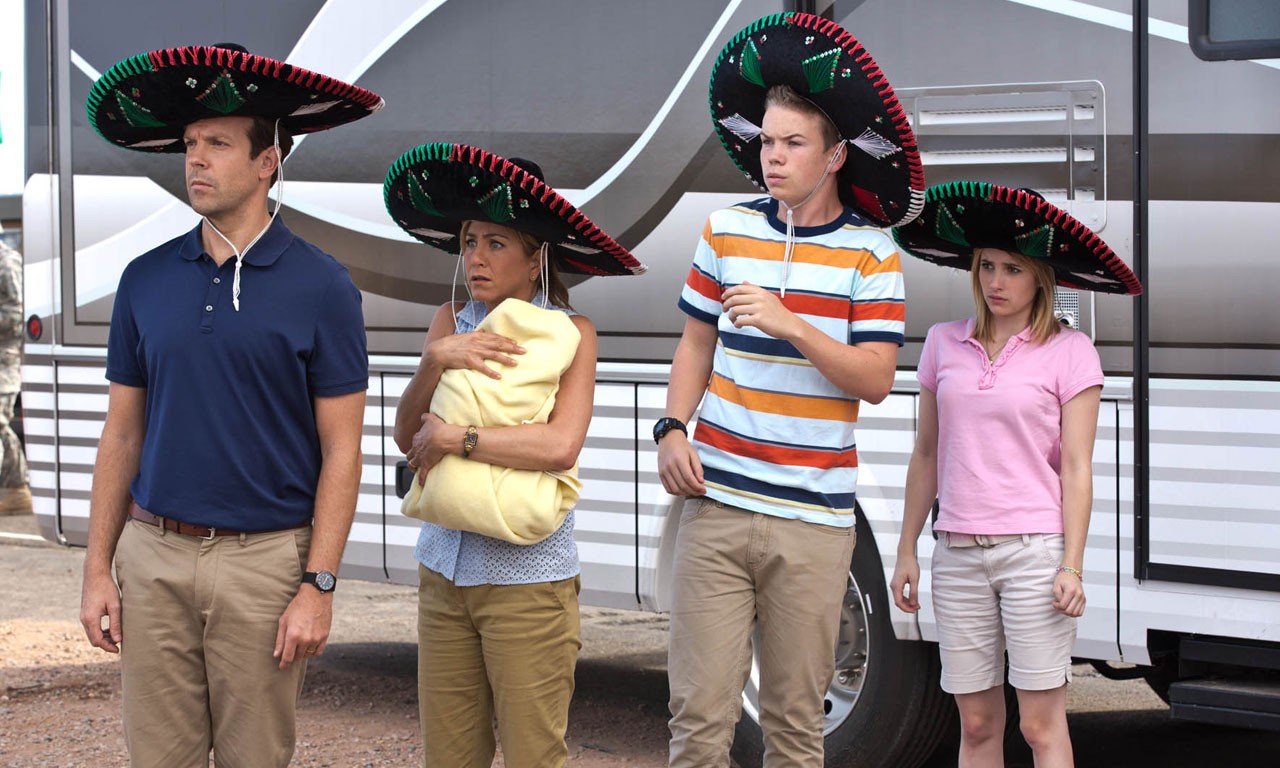
    To enable him to get past the border patrol, David persuades his stripper neighbour Rose (Jennifer Aniston), homeless girl Casey (Emma Roberts), and the 18-year-old dork and fellow apartment dweller Kenny (Will Poulter) to pose as his all-American family, the Millers, planning to hide the weed in an RV and sail right across.
    Of course, things don’t go quite to the script, with the crew ending up being chased by a Mexican drug kingpin, having a series of bizarre encounters with another RV-driving couple (Kathryn Hahn and Nick Offerman), and struggling to keep their masquerade intact.
    The jokes themselves are often sexual or scatological, with gags about wife-swapping, sexual malfunctions, and tampons making prominent appearances, not to mention an unfortunate incident with a spider bite on a set of testicles.
    But while We're the Millers is very raunchy in its humour, at the very heart of it lies a sweet intent, being fundamentally a tale about a bunch of wacky misfits who secretly yearn for the kind of normality some people would take for granted.
    As their journey moves forward, the Millers find themselves assuming the characteristics of a real family. David and Rose develop a sense of parental protectiveness toward their “children”.
    While all of the cast play off each other well, Poulter is a standout and hilarious as the insecure Kenny, whether he's rapping to TLC's Waterfalls or awkwardly learning how to kiss from an inappropriate source.
    As the movie winds up, life lessons are learned by all. In some ways, this is the movie's best joke: that even complete screw-ups can find a sense of belonging when thrown together with other fellow oddballs.


#we'rethemillers


Thursday, 24 January 2013

TOP GUN


MOVIE
Django Unchained
Jamie Foxx, Christophe Waltz, Leonardo DiCaprio, Don Johnson 
Director Quentin Tarantino
Review Ray Chan

Tarantino may have his critics, but this movie probably typifies exactly how brilliant this filmmaker is.
   Bold, brave, blithe and bloody, Django Unchained is an incendiary masterpiece featuring a kick-ass tale of revenge with some awesome performances from its star-studded cast, smart chunks of dialogue punctuated by action, ensanguined altercations and stereotypical Western ballads, and for some unfathomable but highly entertaining reason, Tarantino himself with a ridiculous Australian accent.
    Jamie Foxx is Django (“the D is silent”), a slave being dragged by his masters in chains, when he runs into Dr King Schultz (Christoph Waltz, portraying a good guy for a change).
    Schultz needs Django to identify his former employers so that he can kill them and collect the bounty on their heads, and promises to set Django free once the mission is accomplished.
    They find the odious brothers on the sprawling cotton plantation of Big Daddy (hammed up impeccably by Don Johnson), and it doesn’t take long for Django to dish out some retribution for his past treatment at their hands. Schultz doesn’t care because he gets the reward anyway.
    Then the twists and turns keep coming. After Django relays the story of his missing wife, the wonderfully-named Broomhilda, to Schultz, the pair partner up to hunt bounties all winter with a plan to track her down in the spring and buy her back from her current owner—a vile, mustachioed gentlemen named Calvin Candie (Leonardo DiCaprio) who runs a plantation called Candieland.
    Suffice to say that efforts to rescue Broomhilda don’t go exactly to plan, with the plot meandering through a series of shocks, suspense and surprises, as Candie’s devoted slave Stephen (Samuel L. Jackson) figures out the real reason for Django’s visit.
    Indeed, Jackson’s performance is a highlight. Usually depicted as the rough, no-nonsense law enforcer or a vicious criminal, here he plays an exaggerated and extremely funny character calculated to make the audience laugh and then feel uneasy about how willingly they respond to his over-the-top delivery.
    Overall, the blend of classic film homages, violent spectacle and clever verbal exchanges ensures that Tarantino remains one of the most interesting and innovative movie maestros of his generation.
    On a more serious note, he makes a potent and powerful statement about racial stereotype and racist language, and even includes a post-credit gag to suggest the potential for such language to then be successfully appropriated.
    The end result is what I believe to be Tarantino’s best and most thoughtful film to date.


#djangounchained

Wednesday, 2 January 2013

GODLY SLICE OF PI


MOVIE
Life Of Pi
Suraj Sharmam, Irrfan Khan
Director Ang Lee
Review Ray Chan


It takes the pedigree of an Academy Award-winning director like Ang Lee to have the audacity to tackle what looked like a seemingly impossible literary adaption of Yann Martel's novel.
    Martel's story outlines the life-defining journey of a young man named Pi, whose zookeeping business family decide to travel to Canada from their Indian homeland — lock, stock and menagerie — to escape political problems there.
    
    On the way, their cargo ship gets battered by a fierce storm and capsizes.
    Pi manages to find a life boat, which bit by bit takes on various animals from the sinking vessel — a wounded zebra, a noble orangutan, a cackling, self-serving hyena, a regal Bengal tiger — who in the ensuing days turn on each other in the quest to survive.
    Eventually it’s just Pi and the tiger left stuck on the small vessel in the middle of the Pacific Ocean, a predicament that would test anyone’s sanity.
    To help him endure, Pi digs deep into the recesses of his eclectic convictions that a god exists to keep him alive, and this journey is rendered impeccably by Lee's vision. The colour is electric, with iconic and stunningly sublime shots littered throughout.
    Whether it's magnificent underwater shots of the ship plunging to the watery depths, a grand whale breaching to the skies, or the infinite glacial look of an ocean, Lee's stunning composition is omnipresent, as is the technical wizardry used for the animal stars of the film, which make them wonderfully realistic.
    Veteran Irrfan Khan plays the older Pi, who narrates the tale, while the younger version is represented by Suraj Sharma, who does an impressive job of absorbing the harrowing physical torture without extinguishing his optimism, belief and hope, successfully emoting without any real creatures to play off of.
    If you haven’t read the book, you are in for a treat as you gradually realise the movie is all about symbolism and metaphors.
    As the film nears its end, a rescued Pi tells two versions of his adventures: the animal story and a human interpretation. It’s then that the realisation dawns, if it hasn’t already, that the ragtag group of animals were likely anecdotal manifestations of crew members who clambered on board with Pi.
    After recounting his experiences, Pi asks his rescuers, and indirectly the viewers, which rendition they prefer.
    Pi maintains it was his faith that got him through, and here he provokes a person to believe in the presence of a higher being.
    He is challenging the viewer to consider which version of the world they prefer 
— the one where we make our own way and suffer through the darkness via self-determination, or the one where we are aided by something greater than ourselves (regardless of which diety we may follow).
    Is the tiger in fact how Pi sees God, who helped him get through adversity when all seemed lost? Is the tiger Pi himself?
    Ultimately, Life of Pi is a beautiful allegory about living with acceptance in the face of the most formidable of adversities.
    The consensus from the hardened investigators interrogating Pi as he recovers is that the animal version is too fanciful to believe, but a much happier one to accept.
    “And so it goes with God,” Pi says as the movie ends.

#lifeofpi


Monday, 24 December 2012

I SCREAMED A SCREAM


MOVIE
Les Miserables
Hugh Jackman, Russell Crowe, Ann Hathaway
Director Tom Hooper
Review Ray Chan

IF you like your musicals big, bombastic and blasting on all cylinders, then this is the movie for you.
    The cinematic sweep works pretty well at times, right from the opening scene, in fact: a chain gang of prisoners labouring to pull an enormous ship into dry dock looks like authentic toil, and has a decent shock moment when the camera searches the faces and finds the emaciated Prisoner 24601, Jean Valjean (Hugh Jackman), imprisoned for 19 years for stealing a loaf of bread.
    The protagonist of Victor Hugo’s novel, Valjean is put on the path to goodness by a generous gift, but pursued relentlessly by Inspector Javert (Russell Crowe), who doesn’t believe in redemption.
    Then after 90 minutes, the stage becomes vastly more crowded as other characters from the narrative are introduced.
    Valjean rescues Cosette (Amanda Seyfried) from a couple of unscrupulous innkeepers (Sacha Baron Cohen and Helena Bonham Carter), who then travels to Paris and falls in love with idealistic French student Marius (Eddie Redmayne), who has joined a band of brothers fighting in the revolution.
    Indeed, with the entire saga set in France, it’s interesting to note the cosmopolitan make-up of the cast, which includes Britons, Frenchmen, Americans and Antipodeans, all of whom make no attempt to hide their native accents.
    The exception is Cohen, who for whatever reason adopts a random Inspector Clouseau inflection, which contrasts wildly with the perplexing Jack Wild-esque Cockney-speak of Daniel Huttlestone as the French urchin Gavroche.
    With so many different characters, there are bound to be moments when viewers feel scenes are rushed, or lacking deeper exposition, but any flaws in the adaptation are more than made up for by Jackman’s performance.
    Apart from a solid showing as the anguished lead, Jackman surprises with his tenor vibrato, standing up against the best of the actors who have played Valjean, particularly in What Have I Done, dragging you into the film so completely you can almost feel his spit on you, and on the difficult Bring Him Home, where the verses hit notes that only dogs can hear.
    More surprising and impressive is the portrayal of Fantine by Anne Hathaway.
    Her solo I Dreamed a Dream is the first significant test for director Tom Hooper’s gamble of recording his actors performing live in one take, with flat notes and rough edges preserved and not re-done in the safe haven of a studio.
    The two shining stars really brighten up what we need to remember is foremostly a musical, but unfortunately, not all their peers are as vocally blessed, with the biggest culprit being Crowe.
    It’s not unfair to say that when Les Mis is good, it’s very, very good; but when it is bad, it’s usually because the Gladiator star has tried to sing.
    Crowe, whose professional crooning career peaked with pub band 30 Odd Foot of Grunts, is a sorry simulacrum for the angry Javert, cooing dramatic songs as if they were lullabies.
    Ultimately, adapting beloved oeuvres into a new medium is always a tricky prospect. Whether it's a comic book, a stage play, or in this case, a great work of literature, if makes it to the silver screen, chances are that there is a fairly devoted fan base who will let you know in no uncertain terms if you screw up their baby.
    In Les Mis, if they can overlook the unevenness of some of the musical numbers, they will probably raise their thumbs.
    While there's a slight disconnect from the source material, there's also an undeniable passion and respect for the magnum opus, which runs for more than two-and-a-half hours.
    It may be overlong and even test one’s patience, especially those who are not into Broadway shows or singing and dancing theatre pieces, but as cinematic musicals go, it’s generally one of the more sumptuously-crafted productions in recent years.


#lesmiserables


ATTITUDE WITHOUT ALTITUDE

  MOVIE Supergirl Director Craig Gillespie Review Ray Chan The film begins with a super-powered dog relieving itself in spectacular fashio...