Saturday, 4 September 2021

BITTERSWEET CANDY


MOVIE
Candyman
Director Nia DaCosta
Review Ray Chan

It is arguably a sign of shoddy production values when a viewer struggles to comprehend what’s going on in a movie if he or she either hasn’t seen or has forgotten the original film it’s based on, and there’s no easy-to-follow recap.
    Such was the case with the much-touted, rebooted Candyman, with its progenitor released so long ago (three decades!) that even if you did manage to watch it in a theatre, you’d be forgiven for not remembering the premise.
    So here’s a quick rundown: for many years, the Cabrini-Green complex – a series of dilapidated, graffiti-riddled buildings sandwiched between Chicago's wealthiest neighbourhoods – had been showcased in the media as symbolising the horrors of public housing.
    The titular character was once, a couple of centuries ago, a talented Black painter named Daniel Robitaille, who was murdered for his love of a white woman, and in a gruesome fashion: his hand was hacked off by a lynch mob and a hook jammed into the stump, while his body was smeared with honey as a vengeful swarm of bees proceeded to sting him to death.
    His ashes were scattered across the ground upon which the public housing complex would be erected decades later, from which a legend grew. Say his name five times in front of a mirror and he'll appear – the return of the oppressed, as it were – before swiftly sinking his clasp into the summoner.
    And so the Candyman is a bogeyman born of racism, as indeed was Cabrini-Green, developed to house the under-privileged.
    But now in the present, things have changed. Set in the present day, Nia DaCosta's revival of the franchise returns to a newly-gentrified site, where the crumbling old high-rises have since been torn down and luxury developments gleam in their stead.
    The Black residents are part of the new normal: wealthy, yuppie millenials who enjoy lives of modest luxury. Among them are artist Anthony McCoy (Yahya Abdul-Mateen II) and curator Brianna Cartwright, the new owners of a sprawling apartment in the block.
    Unfortunately, Anthony is in a bit of a rut, his creative spark lost, leading him to feel he can’t fulfil his potential as "the great Black hope of the Chicago art scene of tomorrow".
    That is until he is initiated into the Candyman legend after an encounter with a former Cabrini-Green resident, which provides him with some much-needed artistic inspiration. He calls up the man to see if he can use him to help rejuvenate his mojo, and promptly gets stung by a bee. Slowly, surely, his right hand becomes increasingly infected. From there, you can predict what happens next.
    The movie certainly bears the distinctive imprimatur of Jordan Peele, who co-wrote the screenplay with up-and-comer DaCosta and Win Rosenfeld, and produced it under the banner of his own Monkeypaw Productions. It aligns almost too perfectly with the kind of satire-infused horror-as-racial allegory for which the Get Out director has been lauded.
    But the social critique in this Black-lensed, next gen Candyman lacks the clever metaphor-filled sequences of his previous films.
    Instead of trying to find cleverly concealed Easter eggs, the viewer gets them flung in the face at times: for example, when one of Anthony’s first Candyman-prompted art exhibits, a mirrored bathroom cabinet accompanied by a set of instructions for the conjuring, is entitled 'Say My Name' 
 boldly evoking the Say Their Names movement.
    His festering limb succumbs to rot, to be replaced by a makeshift grapnel, and becomes symbolic of how a once-healthy community in the beehive of apartment blocks has been replaced by a monster.
    Interestingly, the film posits the existence of multiple post-Daniel Robitaille 
Candymen, each a casualty of racially motivated violence – an attempt to expand and update the urban legend for possible future sequels, in which
perhaps they'll actually take the time to explain the mythos behind the madness.

#candyman #universal


Thursday, 5 August 2021

ON THE GROUND


MOVIE
In The Heights
Director John M Chu
Review Ray Chan

West Side Story this ain’t.
    This overbearing adaptation of a screenplay by Lin-Manuel Miranda is a musical with a working-class New York setting, but that’s pretty much where the comparison with the Stephen Sondheim classic ends.
    The title refers to Washington Heights, a mainly Latino neighbourhood at the north tip of Manhattan, where the protagonist Usnavi (Anthony Ramos) runs the corner grocery shop while planning to take over his late father’s business back in the Dominican Republic.
    A framing device depicts a slightly older Usnavi on an idyllic beach, telling his story to an audience of children, who exhibit a commendable patience because In the Heights doesn’t really have a story – at least, not one that needs to be stretched over nearly two and a half hours.
    Basically, the movie revolves around two couples. Usnavi likes Vanessa, who works at the local beauty parlour, and Usnavi’s pal Benny likes Nina, who falls out with her father over her choice to quit university.
    As well, because it’s intended to be a musical, with wildly over-the-top choreographed sequences and flash mob scenes popping out at every major turn, it’s a weirdly sanitised picture of human existence in general: no sex, humour, violence, and only the minimum of bad language.
    Director John M Chu ensures that any drama that exists is never to the point where anything gets truly painful, while also failing to summon enough comedic forays to create a light-hearted balance.
    And then we come to the raison d'etre, the actual musical numbers. While intended to be extravagant, they are over-edited and visually cluttered, not helped by the songs and lyrics crafted but not mastered by that jack of all trades, Miranda himself.
    This reviewer is firmly in the group of those who do not put him on some lofty pedestal as a modern-day Sondheim, in whose league he definitely does not belong.
    Still basking in the afterglow of his Broadway smash hit Hamilton, the playwright is fortunate that he’s still revered as some wunderkind of the stage and musical.
    Yes, there are many other less talented craftsmen out there in the entertainment world. In his favour, Miranda can act, can write, can direct, looks good, and can carry a tune. But songwriting is far from his strongest attribute.
    He lacks the melodic nous of a Richard Rodgers, a Lionel Bart, a Lloyd-Webber, a Richard and Robert Sherman, and yes, a Stephen Sondheim, who graced us with unforgettable lilting masterpieces such as America, Maria, and Tonight, from the afore-mentioned West Side Story.
    On the other hand, see if you can remember any of the tunes from In The Heights, even if you’re game enough to go to multiple viewings.
 
#intheheights


Thursday, 1 July 2021

INTERMINABLE MAEL-STORM


MOVIE
The Sparks Brothers
Director Edgar Wright
Review Ray Chan

As someone who spent his teens obsessed with the British glam rock era, this reviewer initially felt it would difficult to view this documentary without a touch of bias.
    After all, the US band Sparks – essentially the duo of brothers Ron and Russell Mael – was, while unheard of in their homeland, an absolute phenomenon in Pommieland and parts of Europe. 
    Among the group’s admirers have been a plethora of well-known musical artists and movie celebrities, including acclaimed director Edgar Wright, who loved the Maels so much that he devoted this feature to them. 
    The motives are honourable: you can't fault the the Englishman for trying stridently to correct the public perception that Sparks was not just a flash in the pan, but, in fact, an innovative, influential, respected pop duo that is still going strong. 
    Indeed, there's a clearly palpable excitement in the theatre room once the lights dim, with the audience settling itself for an enjoyable refresher course into the prolific output of a pioneering outfit which delved into electronic music well before the synthetic new wave movements of the 80s. 
    And yet. And yet. Unfortunately, it seems Wright has allowed his predeliction with the siblings and their work to get in the way of making a better, shorter film. 
    With unlimited access to the Sparks archives, Wright makes his case to the point of tedium, often going into way too much detail, even as we hear a formidable list of testimonials from the likes of Giorgio Moroder, Todd Rundgren, John Taylor and Nick Rhodes (Duran Duran), Beck, Flea, Patton Oswalt, Weird Al and Mike Myers. 
    At two hours and 20 minutes, the film starts to drag on at the halfway mark. The album-by-album retrospective (25 in all) is quite tiresome; by the time we get to the early 199Os, one really begins to feel the inordinate amount of time this is taking. 
    For a telling comparison, consider how in The Bee Gees: How Can You Mend a Broken Heart, director Frank Marshall was able to comprehensively cover a mammoth musical biography in a tight 107 minutes. 
    To make matters worse, Wright’s fawning ensures The Sparks Brothers lacks any critical perspective. 
    Not everything released was brilliant and, like everything anyone produces, there was certainly some garbage among the gold. But here, the absence of a dissenting voice or two – which would break up the monotony of the adulation – is conspicuous. 
    There are so many gems: Tips for Teens, No 1 In Heaven, This Town Ain't Big Enough, for example .... while the controversially-named Dick Around involves grand choral refrains that eclipse anything Freddie Mercury could dream up. But sadly, many of the songs are only played in snippets. New ears to the music would have little opportunity to work out whether they appreciate the melodies. 
    It seems The Sparks Brothers is a well-made prolonged love letter that is aimed more at existing fans than potential converts, and viewers who are not familiar with the band’s works may well not be awed by the sales pitch.
    It is likely to find more converts when it inevitably hits the streaming channels, where it can be comfortably consumed in two parts. 

#sparksbrothers #universal


Friday, 21 May 2021

QUIET ACHIEVER


MOVIE
A Quiet Place Pt II
Emily Blunt, Millicent Simmonds
Director John Krasinski
Review Ray Chan


A Quiet Place Part II
is quite literally a sequel, picking up directly where its preceding chapter left off.
    Unlike many offerings where the follow-ups do not necessarily occur immediately after the initial episode, Part II is set mere hours later, extrapolating on the first instalment’s cliffhanger ending, which had resilient  mother Evelyn Abbott (Emily Blunt) killing off inhuman attackers who were threatening her and her kids: hearing-impaired Regan and introverted Marcus (Millicent Simmonds, Noah Jupe).
    But there’s a prelude before the story continues, in which the viewer is taken back to the very moment the Abbott clan witnessed first-hand the horrific experience that would forever disrupt and change their lives.
    Via the flashback, we see how the Abbotts reacted to Earth’s new apex predator – blind, emaciated beings with chitinous armour and an acute sense of hearing – and provides an inkling of where they came from.
    Flash forward 474 days, and the surviving members — including Evelyn’s newborn baby whose crying could cost them all their lives — must leave their farm and seek shelter at one of the other post-apocalyptic encampments, marked by bonfires on the horizon. 
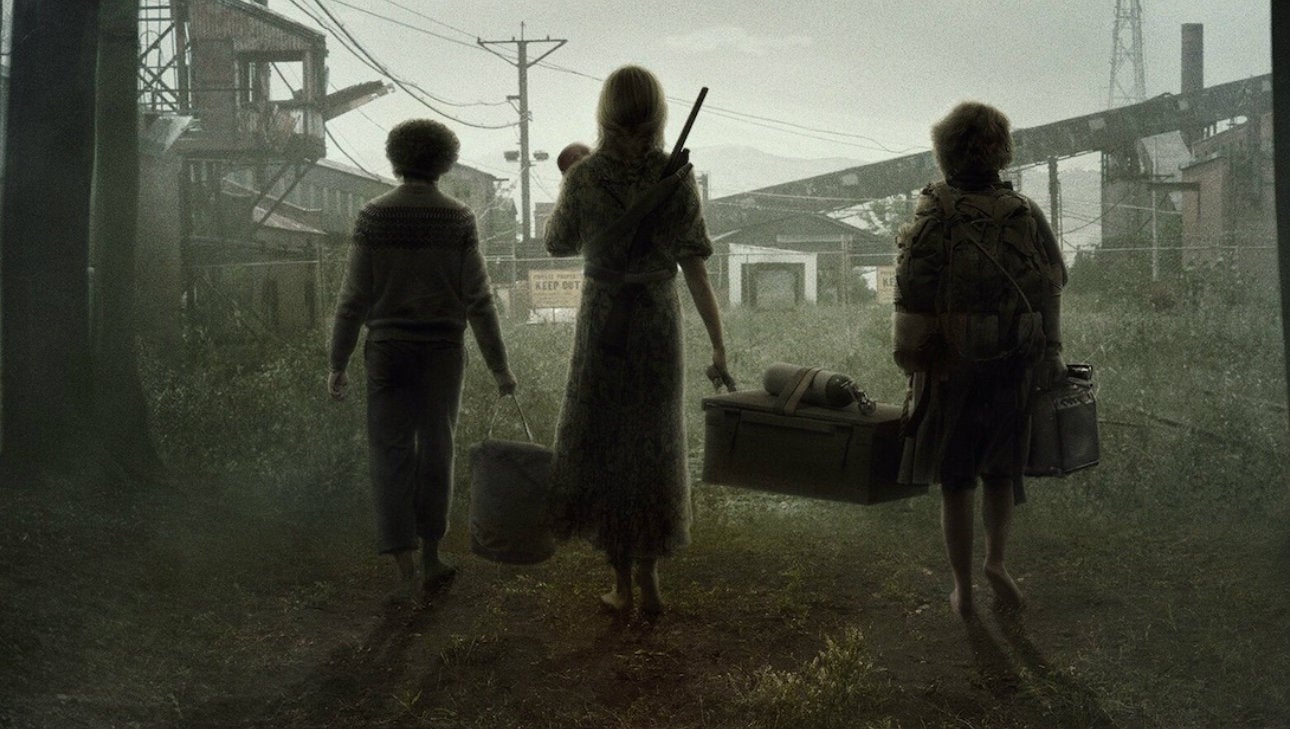
    Still living by a code of silence lest they give their presence away, the Abbotts are lucky that the first person they meet is an old friend, Emmett (Cillian Murphy), who’s been hiding out in an abandoned steel mill. It takes some convincing to guilt him into helping them, but he soon turns out to be a de facto father figure, much like self-sacrificing family patriarch Lee (played by director Krasinski) from the first movie.
    The two leading ladies again take on prominent roles — especially fan favorite Regan, whose cochlear implant already provided an almost-too-convenient defense against the aliens.
     I
t’s Regan’s idea to find the nearest radio station and use her hearing aid to broadcast a signal that could defeat the beasts once and for all. For one so young, Simmonds sparkles with her ability to demonstrate focus and ferocity, intelligence and composure. 
    Getting there is doubly dangerous though, as she and Emmett encounter horrors both human and alien along the way.
    Indeed, this is just one part of an overly complex, three-pronged arc that breaks up the family unit and relegates Blunt to the background.
    One story features Emmett and Regan in the woods, off on their own odyssey, another Evelyn heading back to town for medical supplies, while adjacent to that one, Marcus has to tend to the baby, while also fending off one of the multi-toothed critters.
    It’s perhaps an attempt at a cross-cutting editing technique that appears too ambitious – but kudos for the effort.


    Interestingly, while Part II finished production well over a year ago, some observers might feel there is a deliberate allegorical attempt to link the creatures with the pandemic, which ironically kept the feature’s release in check.
    Indeed, a world where everyone has to stay inside, not talking to strangers, mistrusting all the rest of “those people” out there, feels all too familiar. Hell, even the monsters’ heads look like enlarged COVID molecules.
    Symbolically, the metaphor of familial strength and the “terror” of parenthood (whether offspring can truly be kept safe, no matter what) still come to the fore, but this film also floats the notion of survival and salvation for those who may not be worthy of it.
    However, before audiences can catch their breath and even start to ponder about the themes, it ends on such an abrupt note that they might not find true emotional closure … at least, not until the next inevitable part of the franchise .

#AQuietPlace  #nrcagency


Monday, 19 April 2021

FATALITY ATTRACTION


MOVIE
Mortal Kombat
Lewis Tan, Jessica McNamee, Josh Lawson
Director Simon McQuoid
Review Ray Chan


You’d be surprised to learn that for every person who has played Mortal Kombat – considered one of the best fighting video games of all time – there’s an equal number, or indeed more, who’ve never even heard of it.
    So let’s briefly recap for the uninitiated. At the heart of the game is the tussle between the player and an opponent of his choice in a one-on-one match, involving various combat moves and attacks. The  trademark feature is the Fatality, a finishing move executed against a defeated rival to kill them in a gruesome fashion, some of which have become almost iconic. Indeed, it is often the prime reward for many victorious players, who take macabre pleasure in seeing what form the Fatalities take.
    In the single-player game, the player faces each of the seven playable characters in a series of battles, after which he must then fight in three endurance matches, each of which involves two opponents. After the third endurance match, the player fights the four-armed Goro, followed by a final match against Shang Tsung, the main villain of the piece.
    The challenge for any moviemaker then is to take the simplicity of this fighting platform, and build any sort of storyline around it, incorporating all the various characters, elements, and yes, even the Fatalities. Especially the Fatalities, in fact.
    This 2021 cinematic version of Mortal Kombat follows on from two previous efforts, the second of which was universally panned for its low budget effects, poor plot and endless fight scenes. So this time round, screenwriters Greg Russo and Dave Callaham, director Simon McQuoid and producer James Wan have been careful to learn from previous misjudgments,  pulling out all the stops with the aim of making it the necessary reboot this title required. 
    Here, the lore of the series is brought to a grand and epic scale, showing off the crowded roster of individuals.
    Backed up by some beautiful cinematography, stellar fight choreography and physical stunts that defy logic and gravity, the impressive action sequences brim with energy and excitement, with many based on those found in the video game, such as bicycle kicks and juggling maneouvres.
    It’s replete with lashings of gore, violence, and blood to echo everything that’s a staple of the enduring legacy of this brutal series. There are enough scenes of exploding heads, severed limbs, people split in two, gored bodies and entrail displacements to warrant the extreme R rating, but really, these days the shock effect is minimal because almost everyone has been accustomed to the wizardry that special effects creators can generate.  
    There’s a stronger attempt than in the previous movies to tie up the settings into a cohesive story, although as might be expected, personal development is light and the premise slightly stilted.
    But there’s one definite character improvement which stands out, which truly sets this apart from other video game adaptations where the cast consists of humdrum individuals.
    The scoundrel Kano, played brilliantly by Josh Lawson, has been transformed into a dinky-di Ocker with wisecracking one-liners and a foul mouth that would make a sailor blush.
    The interpretation completely steals the show, bringing pure, unadulterated joy and injecting some much-needed levity at every turn, so much so that when Kano is not on screen, he is genuinely missed. 
    Essentially though, Mortal Kombat is a film crafted almost exclusively for diehard fans, but this time arguably done correctly.
    Despite McQuoid’s claim of taking one step at a time, this movie is clearly planned as a new franchise for Warner Bros, with many Easter egg references and enough bait to set up a sequel should this entry perform well at the box office. 
    And if the wait for a follow-up is too long, surely an interim one-off featuring Lawson as Kano would be worth considering.

*The Australian force is strong in this production. Lawson, McQuoid and Wan all hail from the big country, with most of the movie also shot in South Australia.*

#mortalkombat #universal


Monday, 5 April 2021

NOBODY DOES IT BETTER


MOVIE
Nobody
Bob Odenkirk, Christopher Lloyd
Director Ilya Naishuller
Review Ray Chan

The older moviegoers may recall the 1973 comedy spaghetti western My Name Is Nobody, starring Terence Hill as an unkempt simpleton without a name, but whose façade hid an unerring ability with a gun.
    The premise of an anonymous law enforcer appears to have now been modernised in Derek Kolstad’s Nobody, in which comedy writer Bob Odenkirk trades farce for force, playing a loser who ends up punching above his weight.
    The movie begins by focusing on the humdrum routine of the lead character Hutch, a former feared secret agent who is painted as a failure. His disinterested wife sleeps with several pillows between them, and his son is disillusioned after he refuses to put up a fight against a pair of home intruders.
    When Hutch does finally come out of retirement, it's not because of some profound epiphany nor violent consequence. It’s just because the house robbers took his daughter's kitty cat bracelet, and he doesn't want to let her down.
    And therein lies part of the charm of the film, which has some whimsical undertones to give it warmth. When a bunch of drunken gangsters get on the same bus as a frustrated Hutch and start harassing a girl, he beats them up in a wonderfully choreographed sequence which is all fast, furious and funny, causing the audience to guffaw and recoil in disgust at the same time. 

    Unfortunately for Hutch, one of the injured ruffians is the brother of a Russian mobster named Yulian (Alexey Serebryakov), a crime boss who just likes partying and having fun but isn’t above killing a dude at the smallest provocation. As the film continues, those character quirks fade away until he’s just a routine antagonist dispatching waves of killers to enact revenge on Hutch.
    Watching Odenkirk using all his skills to defend himself – while calling himself just “a nobody” – and gleefully killing Russian gangsters with various forms of firearms is a guilty joy. An unexpectedly amusing recurring theme is Hutch repeatedly giving his backstory to people only to look up and realise they died halfway through the narration.
    Christopher Lloyd is delightful in a supporting role, smuggling in his darker capabilities as Hutch’s father, while a late appearance by RZA as Hutch’s brother is engaging, even though it feels like more could have been done with his character.
    Nobody contains many inspired set pieces and enough bits of vim, verve and viciousness to make it an entertaining experience. Still, the fact that the characters are pretty typical and unsurprising limits the film’s staying power, while the casting of an actor more known for his comedic roles makes every scene feel like it will end with a knowing wink at the camera.
    The film is really kind of ridiculous: but it knows it, which makes it all the more enjoyable.
    *Reviewer's tip: stay for the mid-credits scene.

#nobody #universal

Thursday, 25 March 2021

MONSTER OF A GOOD TIME


MOVIE
Godzilla Vs. Kong
Rebecca Hall, Alexander Skarsgard, Kaylee Hottle
Director Adam Wingard
Review Ray Chan


Everyone’s favourite gargantuan reptile, Godzilla, long seen as a friend of humanity, has started to attack the puny homo sapiens and destroy their towns and cities, seemingly without provocation.
    So what’s up with that? In their desperation, the military and scientists call upon help from the supersized simian Kong – who has been held captive in an artificial simulacrum of his homeland, Skull Island.
    And therein lies the basic premise of this epic monster mash, with Godzilla taking on gorilla, the two creatures squaring off for the alpha title.
    Indeed, it’s not long into the film before the commotion starts, as director Adam Wingard takes the audience up close to the encounters: every punch, every growl, every movement taken in anger, quite unlike previous instalments in which action is obscured behind dust, debris and deluge. There’s even a nod to the original King Kong movie as the oversized ape jumps from skyscraper to skyscraper, in scenes shot in Queensland, no less.
    This the fourth film in this monster universe (after 2019's Godzilla: King Of The Monsters, 2017's Kong: Skull Island and 2014's Godzilla), and one in which the primordial protagonists get the most screen time.
    As such, personal human relationships and characterisation take a back seat, unlike the initial chapters of the franchise when there was an underlying moral conundrum of whether the kaijus should be kept alive to balance the forces of nature.
    That being said, the standout performer is undoubtedly Kaylee Hottle as Jia, a little girl who can communicate with her primate pal, which gives this movie the right amount of heart. The young actress comes from an all-deaf family in real life and steals the show with her charm, innocence and genuine use of sign language.
    While the story won’t win any Oscars, the movie definitely lives up to its title in every way - monster-size entertainment worth catching on the biggest screen possible.


#godzillavskong  #universal 


Sunday, 27 December 2020

LABOURED LABOUR OF LOVE


MOVIE
Wonder Woman 84
Gal Gadot, Chris Pine, Kristin Wiig, Pedro Pascal
Director Patti Jenkins
Review Ray Chan

This year of living dangerously has been sparse in terms of major superheroes gracing the big screen. Even Birds of Prey focussed on minor league characters battling common criminals who were certainly not in the cosmos-shaking leagues of Thanos and Darkseid.
    Ironically, after a golden period of box-office dominance, the one thing DC and Marvel’s greatest heroes couldn’t defeat was a pandemic.
    But now, as the gruelling past 12 months close, one comic book character has emerged like a true hero to defy the odds to make it to the big screen and rescue 2020 from total misery: Wonder Woman.
    Director Patty Jenkins embraces the same essence of innocence and optimism that she harnessed for the 2017 predecessor, illuminating the DC Extended Universe that was once so mired in morally grim seriousness and visually murky settings.
    Although much of the material seems over the top in its preachiness, it’s essentially lifted from the original comics that first enthralled a generation of young readers, embracing the inherent goodness, naivety and sincerity of its central hero. Also thrown in are some nuggets to excite the fanboys, such as the heroine’s invisible jet and the employment of her golden lasso as a true weapon.
    In the midst of political unrest in the US and COVID-induced chaos, it’s clear that Jenkins feels even more empowered this time around to hold firm to Wonder Woman’s intrinsic spirit: that she is a bulwark of truth and honesty, whose physical strength is complemented by the warmth, love and generosity that she radiates.
    Jenkins’ understanding of Diana Prince’s true power is woven firmly into the DNA of Wonder Woman 1984, shining through in its subtle revolutionary imagery and the themes that pit her against Pedro Pascal's shady Maxwell Lord.
    The sequel fast-forwards Diana several decades to the mid-80s, with the immortal character looking as hale and hearty as ever, but still mourning the loss of Steve Trevor (Chris Pine), who died many years before during the war in which the first movie took place.
    But somehow Steve is resurrected, and it all ties in with a magical artifact that is the focus of the story. To reveal more would spoil the movie, but suffice to say it throws up a moral conundrum that is not extrapolated upon.
    Nevertheless, combined with the film’s Washington DC setting, there’s a clear allegory and reference to the present day Trumpian regime, with the smarmy Lord even proclaiming “I’m not a con man… I’m a television personality”.
    The movie also snares in Kristin Wiig's Barbara Minerva — a nerdish geologist who eventually transforms into the Cheetah, one of Diane’s arch-nemeses from the comics.
    The encounter with the villainous vamp results in some well-choreographed battle scenes, but coming as it does after an intense confrontation with Lord, seems anticlimactic, and really serves only to extend the film by several lengthy, and perhaps unneeded, minutes.
    And wait, there’s more: just as the more restless viewers feel the film is nearing its end after more than two hours, it drags on further with image after image of Diana riding the air currents, flitting through the skies and riding lightning. Perhaps the warrior’s ascension skyward is a symbol of her pursuit of changing the world for the better, but too much is too much.
    That being said, it’s apparent Jenkins recognises the power of the imagery she’s committing to the screen, exemplified by the theme of watching a young girl transformed into action hero, impressively telegraphed by a jubilant opening sequence in which a young Diana competes in an Olympic-style Amazonian contest.
    Undeniably though, the heart and soul of Wonder Woman 1984 is  Gal Gadot, whose grace, goodness and femininity still feels refreshing amid a crowded landscape of ripped male heroes.
    WW 1984 is far from perfect. But despite some of the shortcomings mentioned, it succeeds in delivering the blockbuster thrills that 2020 has sorely missed.
    And hokey though the message is, it offers the hope that humanity may just carve out a brighter future for itself.
 
#wonderwoman84#   #buzzmarketing#

Friday, 11 December 2020

AND THE SINGERS SANG THEIR SONGS


MOVIE
The Bee Gees: How Can You Mend a Broken Heart
Director Frank Marshall
Review Ray Chan


This reviewer will say it here and now: the Gibb brothers rank up there among the top melody-makers in modern contemporary music history, easily rubbing shoulders with the likes of Rodgers and Hammerstein, Lennon-McCartney, Andrew Lloyd-Webber and Burt Bacharach.
    While their lyrics may arguably fall short on closer scrutiny, their abilities to craft lilting tunes and gorgeous refrains are almost unparalleled.
    It’s almost criminal that the Bee Gees continue to be dismissed by self-opinionated critics who consider themselves too cool to be associated with a group whose members had more talent in the tips of their fingers than most humans. This documentary, directed by Frank Marshall, may go some way in casting the Gibbs in a more appreciative light.
    Most of us who live in Australia know the basic history of the wonder trio: how they came out here at a young age, cut their teeth on the local scene, and went back to the UK and ensuing superstardom and disco infamy.
    This revealing narrative goes a step further in exploring those developments. It’s less of the usual angle you might expect (i.e. we had them all wrong!) and more of a reckoning with the profound degree of artistry and accomplishment that should be the last word on any Bee Gees story.
    The movie is also a unique consideration of the rise and fall of popular figures, and how they learn to live with it.
    Spending almost no time on the Gibb brothers’ time in Australia, the movie instead heads straight into how success and fame was achieved through raw determination: Hugh Gibb, the father of Barry and twins Robin and Maurice, was a musician who simply believed his sons’ sublime harmonies and knack for songwriting deserved as much or more attention than, say, the Beatles.
    He audaciously wrote to and offered up his cheerfully ambitious offspring to Beatles manager Brian Epstein, who then handed them over to a subordinate, Robert Stigwood. The rest is pop music history.
    Marshall’s film succeeds by featuring interviews with the musicians and producers associated with the Gibbs, as well as the brothers themselves. We get to see and hear seminal people behind the scenes, such as producers Arif Mardin and Albhy Galuten, and the oft unheralded members of the band during the golden years: guitarist Alan Kendall, drummer Dennis Byron, and the under-rated keyboardist Blue Weaver, who contributed heavily to many of the group’s offerings.
    With archival footage and music cues that will invariably lure you out of your chair (or have you choked up during those achingly perfect chord progressions in the band’s ballads), The Bee Gees insists the Gibbs’ musicianship and prolonged success is as impressive as anyone in the rock pantheon.
    Even before the mid-70s, with masterpieces such as To Love Somebody, Massachusetts,  I Started a Joke, Run To Me, and How Can You Mend a Broken Heart, their standing in the music annals was already assured. 
    The footage and music from the band’s initial dalliance with fame is indeed more fascinating than the Saturday Night Fever superstardom and unwarranted backlash that lurked ahead. The documentary features several musicians of note  – Eric Clapton, Coldplay singer Chris Martin, Oasis’ Noel Gallagher, Nick Jonas, Justin Timberlake, to name just a few – all of who share a love, admiration and respect for the Gibb heritage and legacy.
    Chronicled also is how when working with Mardin on the song Nights On Broadway, Barry was pushed to improvise near the song's end, eliciting a sonic falsetto he never knew he had. That, more than anything, put the Bee Gees' stamp on popular culture — a new sound which led to a level of fame and riches the brothers never imagined, but also inadvertently became synonymous with the disco movement, which started to become increasingly criticised.
   The brothers were hurt and confused by the sudden backlash to  Saturday Night Fever and their input to it; record companies started dropping disco acts, and everyone’s gaze was about to turn toward MTV.
    But genius doesn’t lie hidden. The brothers reinvented themselves once more, this time as master collaborators and surefire love-song wizards writing for others, including brother Andy (three No 1s), Barbra Streisand (Guilty, Woman In Love), Dionne Warwick (Heartbreaker), Samantha Sang (Emotion), Diana Ross (Chain Reaction, Experience), Celine Dion (Immortality) and Dolly Parton and Kenny Rogers (Islands In The Steam, Eyes That See In The Dark).
    Somewhat inexplicably, the doco completely ignores the triumphant resurgence of the band in the late 80s and throughout the 90s, when they stormed back into the charts and found a new legion of fans (with songs such as One, You Win Again, Alone and For Whom The Bell Tolls), although there is mention of due respect when they were inducted into the Rock and Roll Hall of Fame in 1997.
    It also skims over the deaths of Maurice and Robin all too quickly, yet their occurrence certainly adds to the recurring theme of loss, poignantly wrapping up the restrospective.
    “I can’t honestly come to terms with the fact that Robin, Maurice and their younger brother Andy are not here anymore. I’ve never been able to do that,” Barry says.
    “I’d rather have them here and no hits at all.”

#beegees# #nbcuniversal#

Saturday, 29 February 2020

INVISIBLE WOMEN


MOVIE
The Invisible Man
Elizabeth Moss, Oliver Jackson-Cohen
Director Leigh Whannell
Review Ray Chan


The Blumhouse studio is notoriously hit and miss, with the stale Fantasy Island the most recent casualty, bombing on all levels.
    But when it’s good, it’s very very good, exemplified by Universal’s latest entry in its classic horror cinematic universe, The Invisible Man, which follows on from the first movie in the series, The Mummy.
    Screenplay writer and director Leigh Whannell recognises that superficial shock and awe seem to be remnants of the past these days, and looks elsewhere for the scares. Indeed, filmgoers are now so used to special effects that not even the grisliest of made-up monsters can inflict more than just the feeblest of frights.
    The real horrors are the ones that do not disappear when the lights come up, those that lurk just outside the theatre doors, and, as the movie’s name metaphorically suggests, lie invisible within the community.
    That’s where this offering, like its stablemate Get Out, are so effective, as Whannell injects the classic H.G. Wells novel with verisimilitude and relevance.
    The story involves Cecilia (Elizabeth Moss), who has recently escaped her abusive boyfriend, optics scientist Adrian Griffin (Oliver Jackson-Cohen), and is now staying at the house of her friend James and his daughter.
    When Cecilia learns from Adrian’s brother that he committed suicide and left her several million dollars, it seems that she is safe, but still feels uneasy as she is tormented by an unseen attacker.
    Cecilia is convinced that Adrian is somehow still with her, but no one believes her, including her friends and her sister Alice. Is Adrian indeed haunting her from beyond, or is there something more sinister afoot?
    The camera floats from scene to scene, imbuing a sense of dread and foreboding in even the most ordinary settings.
    The nature of the antagonist is such that the audience never knows where the next attack is coming from, even when it’s looking right at it, and so the scares evoke real tension and fear – somewhat akin to guessing when the shark would strike next in Jaws.
    At the crux of the matter is the issue of domestic violence 
 the real invisible menace here  and the movie’s impact is certainly made that much stronger because of current events involving Harvey Weinstein, and closer to home, the Hannah Clarke tragedy.
    Indeed, in many cases of violence in the home, it's often the victimised females whose plights go unseen. Those who have experienced this kind of trauma may feel uncomfortable as the film may bring those feelings to the fore.
    But while the fears under the spotlight are real, The Invisible Man uses them as fuel for its effectiveness, never mocking them, and always taking them seriously.
    As thoughtful as it's entertaining, as disturbing as it's frightening, the movie stays with you after you leave the cinema, proving its true worth indeed as a horror offering par excellence.

 #theinvisibleman#  #universal#


Monday, 10 February 2020

SHINY JEWELL


MOVIE
Richard Jewell
Paul Michael Hauser, Kathy Bates
Director Clint Eastwood
Review Ray Chan

BASED on true events, this movie recounts the cautionary tale of Richard Jewell (Paul Walter Hauser), the security guard who made national news in 1996 – first as a hero, when he discovered a satchel of bombs in Atlanta’s Centennial Park during the Summer Olympics and helped lead spectators away from the blast zone, then as a villain, depicted as a frustrated law enforcement wannabe who might have planted the explosives in order to glorify himself as a saviour.
    Jewell is a dreamer obsessed with carving out a career in the police force, painstakingly conscientious in his endeavours to maintain law and order, even going beyond his duties to targeting traffic offenders while employed as a college security officer.

    As a chunky, solitary and awkward individual still living at home with his mother (Kathy Bates), he became a suspect simply because the FBI believed his profile suited that of a tyro terrorist who wanted his 15 minutes of fame.
    The movie takes viewers through the media circus that enveloped Jewell and his small circle of family and friends, including the lawyer he hires to defend him, Watson Bryant (Sam Rockwell).
    Big and boyish at the same time, he exudes an aura of naivete and innocence, as he comes to grips with his new-found fame, initially disbelieving that he is seriously being considered a person of interest.
    The defining characteristic of Hauser’s performance early on is an earnest eagerness to help in the investigation in any way he can, an attribute that is quickly taken advantage of by FBI agents, who – led by the uncompromising Jon Hamm – believe Jewell of such low intellect that they try to prise a signed declaration of guilt from him.
    While initially unfailingly deferential, insisting on the existence of a professional kinship with his persecutors – even as they conceal their snickers at his references to “cop-to-cop” camaraderie – the burly babe in the woods eventually comes to realise the contempt in which he’s held, an epiphany that is emotionally heartfelt and poignant.
    Thanks to the resilience of the prickly Bryant, though, Jewell gradually gains a semblance of self-worth, while quickly losing faith in the religion of authority.
    Hauser’s portrayal of the child-like titular character is wonderful, and viewers cannot help but warm to the only son who just wanted to serve on the side of the law and make his mama proud.
    The movie ends on a melancholy note when, several years later, Bryant tells an exonerated Jewell – who has made his way back into a police desk job – that the real bomber has confessed to the crime.
    But he doesn’t show any satisfaction, his capacity to participate in the system forever disturbed.
    Gone is the ambitious swagger of the campus cop, now disaffected to the point of simple self-reflection, and questioning himself if he really is content to wear the badge.


#richardjewell #buzzmarketing#


ATTITUDE WITHOUT ALTITUDE

  MOVIE Supergirl Director Craig Gillespie Review Ray Chan The film begins with a super-powered dog relieving itself in spectacular fashio...